Overnight you keep 49–70% of the label, and a fridge needs about 1,000 W of surge. Size by the first number, choose by the second — every unit here is LiFePO4.
Three sizes, one pick each
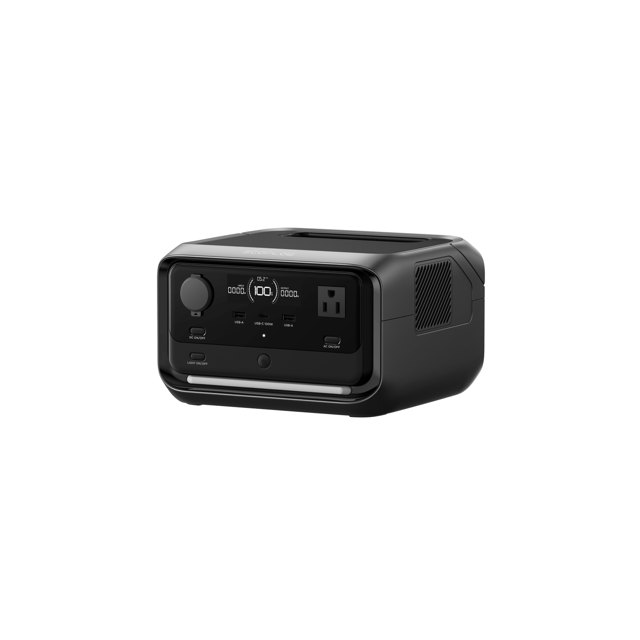 EcoFlow RIVER 3 Plus
600 W in a 10 lb box — it starts things the 300 W units refuse.
The catch: 286 Wh: one CPAP night uses most of it.
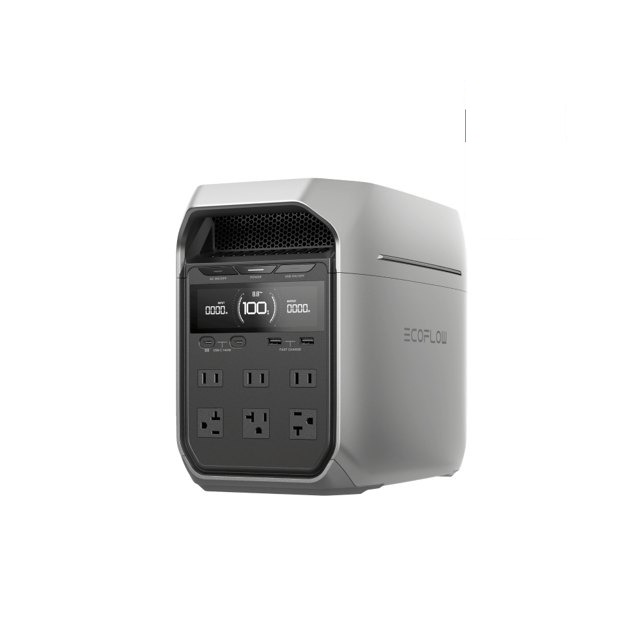 EcoFlow DELTA 3 Plus
A 10 ms UPS and an 1,800 W inverter — the all-rounder if the outage matters more than the weight.
The catch: 27.6 lb — 3 lb heavier than the Anker, for less output.
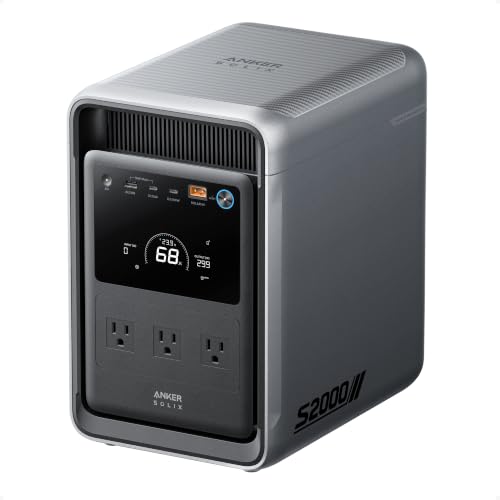 Anker SOLIX S2000
2,010 Wh for $650 — the cheapest watt-hours of any portable unit here; only a fixed 48 V home battery beats it.
The catch: 1,500 W continuous: a big battery with a small inverter.
Prices and ratings: Amazon, checked 2026-09-06. Two of the three picks earn us nothing — that is the ranking, not a tactic.
Every portable power station, side by side
Only the columns that decide it. Grouped by size; the first column stays put when you scroll sideways on a phone.
| Model | Cont. W | Surge W | Label Wh | Weight lb | AC to full | Amazon | |
|---|---|---|---|---|---|---|---|
| Grab-and-go · ≈300 Wh | |||||||
| 600 | 1,200 | 286 | 10.4 | 60 min | — | Amazon → | |
| 300 | 600 | 288 | 8.2 | 120 min | — | Maker → | |
| 300 | 600 | 288 | — | 50 min | $300 ★4.6 · 1,847 | Amazon → | |
| 600 | — | 288 | — | — | $219 ★4.4 · 750 | Amazon → | |
| 350 | — | 297 | — | — | — | Maker → | |
| One-kilowatt all-rounder · ≈1 kWh | |||||||
| Model | Cont. W | Surge W | Label Wh | Weight lb | AC to full | Amazon | |
| 1,800 | 3,600 | 1,024 | 27.6 | 56 min | — | Maker → | |
 | 2,000 | 3,000 | 1,024 | 24.9 | 49 min | $530 ★4.7 · 1,432 | Amazon → |
| 1,500 | 3,000 | 1,070 | 23.8 | 60 min | $499 ★4.7 · 3,574 | Amazon → | |
| 1,800 | 3,600 | 1,024 | — | — | $449 ★4.4 · 586 | Amazon → | |
| 1,800 | — | 1,152 | 37 | — | $599 ★4.6 · 1,841 | Amazon → | |
| 600 | — | 677 | 20.9 | 118 min | — | Maker → | |
| Home backup · 2 kWh and up | |||||||
| Model | Cont. W | Surge W | Label Wh | Weight lb | AC to full | Amazon | |
| 1,500 | 3,000 | 2,010 | — | — | $650 ★4.6 · 150 | Amazon → |
| 3,000 | 6,000 | 2,042 | — | 120 min | $899 ★4.7 · 187 | Amazon → | |
| 2,600 | — | 2,074 | — | — | $799 ★4.7 · 654 | Amazon → | |
| 4,000 | 8,000 | 4,096 | — | — | — | Amazon → | |
| 3,840 | — | 2,765 | — | 65 min | $1,699 ★4.6 · 70 | Amazon → | |
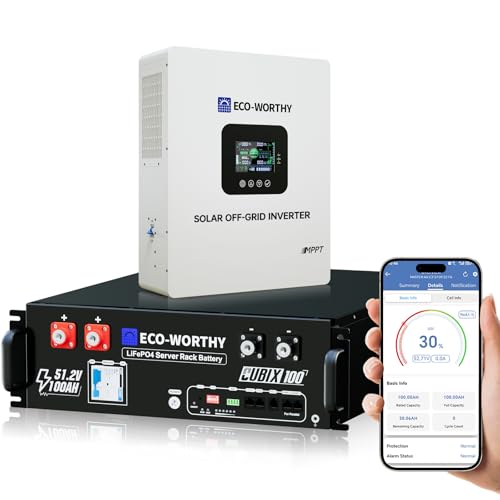 | 5,000 | — | 5,120 | — | — | $1,550 ★4.3 · 44 | Amazon → |
| 2,000 | — | 1,505 | — | — | — | Maker → | |
Highlighted = highest in its size. Continuous W must exceed what you run; surge W must exceed what it takes to start. Dashes are figures we could not verify.
All specifications: surge, chemistry, cycles, solar input, expansion, UPS, sources
| Model | Surge W | Chemistry | Cycles | Solar in W | Expandable | UPS | Source |
|---|---|---|---|---|---|---|---|
| Grab-and-go | |||||||
| 1,200 | LiFePO4 | 3,000 | 220 | to 858 Wh | 10 ms | ecoflow.com spec sheet; Amazon listing title | |
| 600 | LiFePO4 | 3,000 | 100 | — | — | jackery.com product page | |
| 600 | LiFePO4 | — | 100 | — | — | ankersolix.com; Amazon listing title | |
| — | LiFePO4 | — | — | — | — | Amazon listing title (288Wh 600W LFP) | |
| — | LiFePO4 | — | — | — | — | goalzero.com collection page | |
| One-kilowatt all-rounder | |||||||
| Model | Surge W | Chemistry | Cycles | Solar in W | Expandable | UPS | Source |
| 3,600 | LiFePO4 | 4,000 | 500 | to 5 kWh | 10 ms | ecoflow.com spec sheet | |
| 3,000 | LiFePO4 | 4,000 | 600 | yes (expansion battery) | 10 ms | ankersolix.com; Amazon listing title; Outdoor Life weight |
| 3,000 | LiFePO4 | 4,000 | 400 | — | — | jackery.com; Amazon listing title | |
| 3,600 | LiFePO4 | — | — | — | — | bluetti.com; Amazon listing title (1024Wh 1800W / 3600W surge) | |
| — | LiFePO4 | — | — | — | — | Amazon listing title; Outdoor Life weight and low-draw result | |
| — | LiFePO4 | — | — | — | — | goalzero.com; Outdoor Life weight/recharge | |
| Home backup | |||||||
| Model | Surge W | Chemistry | Cycles | Solar in W | Expandable | UPS | Source |
| 3,000 | LiFePO4 | 10,000 | — | — | — | Amazon listing title (2,010Wh, 1,500W, UPS); ankersolix.com (10,000 cycles, 3,000 W peak) |
| 6,000 | LiFePO4 | 4,000 | — | to 12 kWh; two units paralleled to 24 kWh / 240 V | — | jackery.com; Amazon listing title | |
| — | LiFePO4 | — | — | — | — | bluetti.com; Amazon listing title (2073.6Wh 2600W) | |
| 8,000 | LiFePO4 | 4,000 | 2,600 | to 12 kWh with one battery; 36 kWh with six | — | ecoflow.com; Amazon listing title | |
| — | LiFePO4 | — | — | to 58 kWh (maker claim) | — | Amazon listing title (2764.8Wh 3840W); Notebookcheck (65-min TurboBoost, 58 kWh expansion) | |
| — | LiFePO4 | — | — | — | — | Amazon listing title (5120Wh LiFePO4, AC 5000W inverter) |
| — | LiFePO4 | — | — | — | — | goalzero.com collection page | |
Cycle counts are to 80% capacity unless the maker states otherwise (Jackery quotes 70%).
What the label says vs. what came out of the outlet
TakeawayOvernight you keep half to two-thirds of the label. Best: Goal Zero Yeti 700 70%, EcoFlow DELTA 2 67%. Worst: Jackery Explorer 1000 v2 49%. At a 380 W load every unit held 83–92% — the gap is the inverter running itself.
The grey track is the number on the box (100%). Amber is what an independent tester drew out at a 34 W load before the unit shut down; the pale tick is the same unit at 380 W.
Where the labels differ. Anker SOLIX C1000 Gen 2: tested at a 1,056 Wh label; the listing we priced states 1,024 Wh; Jackery Explorer 1000 v2: tested at a 1,265 Wh label; the listing we priced states 1,070 Wh. The percentages above are Outdoor Life’s own, computed against the label of the unit they tested.
The same numbers in a sentence
Outdoor Life’s figures, one unit per line:
- EcoFlow DELTA 2 — label 1,024 Wh. At 34 W: 690 Wh (67%). At 380 W: 900 Wh (88%).
- Anker SOLIX C1000 Gen 2 — label 1,056 Wh. At 34 W: 650 Wh (62%). At 380 W: 950 Wh (90%).
- Oupes Mega 1 — label 1,024 Wh. At 34 W: 610 Wh (60%). At 380 W: 940 Wh (92%).
- Jackery Explorer 1000 v2 — label 1,265 Wh. At 34 W: 620 Wh (49%). At 380 W: 1,090 Wh (86%).
- Goal Zero Yeti 700 — label 677 Wh. At 34 W: 480 Wh (70%). At 380 W: 560 Wh (83%).
- BLUETTI AC180 — label 1,152 Wh. At 34 W: 622 Wh (54%). Not run at 380 W.
Measured by Outdoor Life, published 9 January 2026: each unit ran a ~34 W grow light and, separately, a ~380 W dehumidifier until shutdown. We did not run these tests ourselves; we are reporting their numbers. Units in our comparison that they did not measure are not shown here.
Will it get you through?
Three things people actually buy these for, each with how long it has to last. Each cell is one verdict for one size: ✓ covers it, △ falls short (with how far), or won’t start.
Arithmetic, not a claim: label Wh × 62% for loads under 100 W (× 87% above) ÷ the load — the middle of Outdoor Life’s measured results above. Appliance wattages are typical; read the plate on yours. “Won’t start” = continuous rating below the running load, or surge rating below the start-up peak.
TakeawayOnly 1 kWh and up gets a CPAP through the night. The 300 Wh class gives about 4 hours. A full day of refrigerator is beyond every pick here — 2 kWh does about half a day; buy two, or the 4 kWh DELTA Pro 3. A space heater: under an hour and a half on anything. → EcoFlow DELTA 3 Plus · see it
Will it even start?
TakeawayAnything with a motor beats 300 W at start-up. Our small pick starts a fridge only because it is a 600 W unit — and then runs it under 2 hours. For a fridge, buy 1 kWh; for a well pump, 3,000 W. The 300 W units are for electronics. → EcoFlow RIVER 3 Plus · check price
Motors draw several times their running wattage for a second at start-up. Dark bar = start-up peak, pale bar = steady running; the two faint lines are the 300 W and 1,800 W ceilings. Right: whether each of our three picks starts it.
A unit’s surge rating handles the peak for a second or two, but only if the surge figure exceeds the start-up number — and the continuous figure still has to exceed the running number. Typical values; compressors and pumps vary. Chips = our three picks.
Size it for your load, not the other way round
Uses the same 62% / 87% usable factors as the chart above. Add your loads together if you run several at once.
Choose in about a minute
What is the biggest thing you need to start?
Fridge, pump or heater → skip the 300 W units entirely. Laptops and a CPAP → the small tier is enough, and it is the one you will actually carry.
Small loads for hours, or big loads for minutes?
Overnight CPAP or a router for a day: usable capacity is ~60% of the label, so buy bigger than the arithmetic suggests. Microwave and tools: you will get ~85–90%.
Do you expect this to grow?
If a longer outage next year is plausible, buy the unit with an expansion path (Jackery 2000 Plus, DELTA 3 Plus / Pro 3, Apex-class BLUETTI) rather than a second stand-alone box.
Do you need 240 V?
Well pumps, dryers, some HVAC. Only the DELTA Pro 3 does it from one unit; the Jackery does it with two. Otherwise ignore the whole question.
Is it LiFePO4?
Everything on this page is. Units that do not state a chemistry often are not LiFePO4 — treat an unstated chemistry as unknown, not as LiFePO4. If a listing does not say LiFePO4 / LFP, assume it is not.
Short version: small → EcoFlow RIVER 3 Plus · 1 kWh → EcoFlow DELTA 3 Plus · 2 kWh+ → Anker SOLIX S2000
Grab-and-go — ≈300 Wh
A 40 W CPAP for about 4 hours — half a night. Only the 600 W units start a fridge, and run it under 2 hours.
EcoFlow RIVER 3 Plus
600 W in a 10 lb box — it starts things the 300 W units refuse.
Buy this if: You want one small unit that can occasionally start something bigger than a laptop.
The catch286 Wh: one CPAP night uses most of it.
Why we say that — and where it falls short
600 W continuous with a 1,200 W surge is double what the other small units manage, so it starts a small appliance the 300 W units simply refuse. One-hour AC recharge.
What it does well
- 600 W / 1,200 W surge — twice the output of the Jackery and Anker at this size
- Expandable to 858 Wh with an extra battery, which no other unit here does
- About 1 hour from empty on AC; ≤10 ms UPS switchover
Where it falls short
- 286 Wh is 286 Wh: at 40 W overnight you are using roughly 180 of them
- Heavier than the Jackery (10.4 lb vs 8.2 lb)
Specs: ecoflow.com spec sheet; Amazon listing title. We earn nothing on this brand; linked anyway.
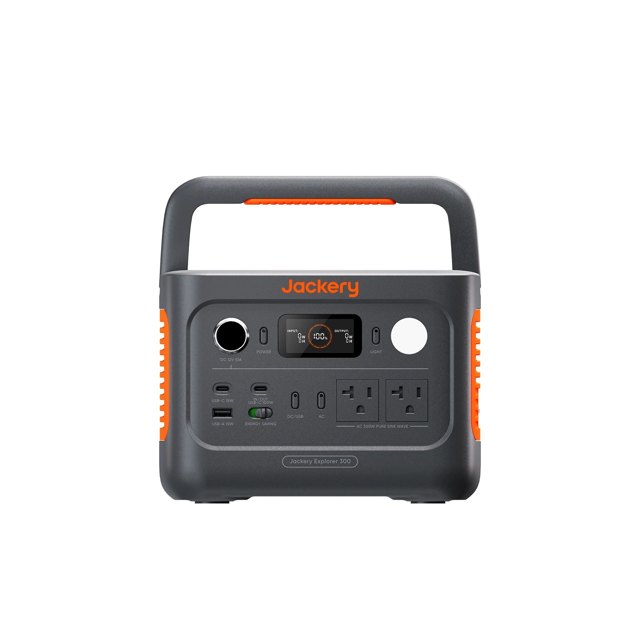
Jackery Explorer 300 Plus
8.2 lb — the one you will actually carry.
Buy this if: Weight matters more than output — a laptop, phones, a CPAP, a camera bag.
The catch300 W ceiling: no fridge, no kettle.
Why we say that — and where it falls short
The lightest unit in the group and the simplest to live with — one AC outlet, one USB-C, one USB-A, a car port. 300 W is the ceiling, and it is a hard one.
What it does well
- 8.2 lb — you will actually carry it
- LiFePO4, 3,000 cycles: the same chemistry as the big units
- Two-hour AC recharge is fine for a unit this size
Where it falls short
- 300 W continuous / 600 W surge: no fridge, no kettle, no hair dryer
- Only one AC outlet
- Solar input tops out at 100 W
Specs: jackery.com product page. Affiliate programme pending — this link earns us nothing today.

Anker SOLIX C300
Eight ports, two of them 140 W USB-C; 80% charged in 50 minutes.
Buy this if: You run mostly USB-C gear and want to skip the inverter losses entirely.
The catchSame 300 W wall as the Jackery.
Why we say that — and where it falls short
Eight ports on a 288 Wh unit — three AC, three USB-C (two at 140 W), USB-A and a car socket — and 80% in about 50 minutes on the wall. Same 300 W ceiling as the Jackery.
What it does well
- Two 140 W USB-C ports: charges a 16-inch laptop at full speed without the inverter
- Three AC outlets on a unit this size
- About 50 minutes to 80% on AC
Where it falls short
- 300 W continuous — the same wall the Jackery hits
- Cycle rating not published on the page we checked, so we left it blank
- There is also a 'C300 DC' with no AC outlets at all — check which one you are buying
Specs: ankersolix.com; Amazon listing title. We earn nothing on this brand; linked anyway.

BLUETTI Elite 30 V2
600 W for $219 — the cheapest 600 W here.
Buy this if: You want 600 W in the small size and price beats the EcoFlow’s expandability for you.
The catchSurge, weight and cycles not verified.
Why we say that — and where it falls short
The other 600 W small unit, and the cheapest here at $219 on Amazon. BLUETTI’s listing title gives capacity, output and chemistry and nothing else we could verify, so the rest of its row is blank.
What it does well
- 600 W continuous, matching the EcoFlow, for less money
- 750 Amazon ratings at 4.4
- LiFePO4
Where it falls short
- Surge, weight, cycles and recharge time not verified — blanks are ours
- No expansion path, unlike the RIVER 3 Plus
Specs: Amazon listing title (288Wh 600W LFP). We earn a commission if you buy through this link.
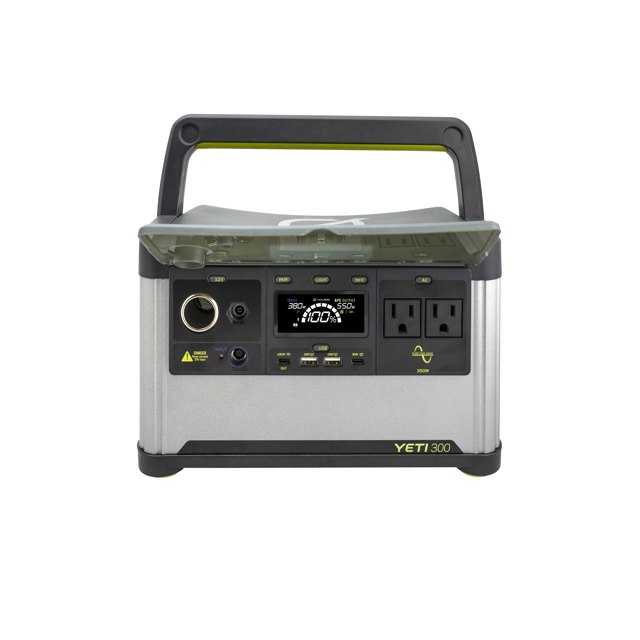
Goal Zero Yeti 300
Goal Zero’s ecosystem and the longest track record.
Buy this if: You already own Goal Zero panels or accessories and want the ecosystem.
The catchAbout $100 more than the EcoFlow for 350 W.
Why we say that — and where it falls short
Included because Goal Zero is the brand people compare against, and because its Yeti 700 posted the most consistent long-term storage retention in the test we cite. At $349.95 list it is the most expensive 300-class unit here.
What it does well
- Six-generation Yeti line; the brand with the longest track record
- LiFePO4 across the whole current range
Where it falls short
- 350 W continuous; surge not stated on the page we checked
- List price is roughly $100 above the EcoFlow and Jackery
- We could not verify weight or recharge time — blanks below are ours, not theirs
Specs: goalzero.com collection page. We earn nothing on this brand; linked anyway.
One-kilowatt all-rounder — ≈1 kWh
Starts a fridge and runs it about 6 hours; a CPAP for two nights; a space heater for half an hour.
EcoFlow DELTA 3 Plus
A 10 ms UPS and an 1,800 W inverter — the all-rounder if the outage matters more than the weight.
Buy this if: You want the unit that wastes the least of its battery on small overnight loads.
The catch27.6 lb — 3 lb heavier than the Anker, for less output.
Why we say that — and where it falls short
1,800 W continuous, 3,600 W surge, 56 minutes to full, 4,000 cycles to 80%, ≤10 ms UPS and expandable to 5 kWh. Its predecessor (DELTA 2) held the best usable-capacity numbers in the Outdoor Life test at both loads.
What it does well
- Predecessor measured 67% usable at 34 W and 88% at 380 W — best low-draw result in the group
- 10 ms UPS: plug the fridge or the modem through it and forget it
- 4,000-cycle rating vs 3,000 on the DELTA 2 it replaces
Where it falls short
- 27.6 lb; the Anker is about 3 lb lighter with more output
- Expansion batteries cost nearly as much as the unit
Specs: ecoflow.com spec sheet. We earn nothing on this brand; linked anyway.
Anker SOLIX C1000 Gen 2
2,000 W from a 25 lb box, full in 49 minutes.
Buy this if: Your loads are big and short — a fridge, a microwave, tools — rather than small and long.
The catchOnly 62% usable at 34 W — weak for CPAP-only nights.
Why we say that — and where it falls short
2,000 W continuous from a 24.9 lb box, full in 49 minutes, 600 W of solar input. Outdoor Life measured 90% usable at high draw — but only 62% at 34 W, so it is the worse choice of the two for a CPAP-only night.
What it does well
- 2,000 W continuous / 3,000 W peak — the most output in this tier
- Outdoor Life measured 950 Wh usable at 380 W: 90% of the label
- 600 W solar input, 49-minute AC recharge, 4,000 cycles
Where it falls short
- Measured 650 Wh usable at 34 W (62%): the inverter overhead shows on small loads
- Expansion battery is a separate purchase
Specs: ankersolix.com; Amazon listing title; Outdoor Life weight. We earn nothing on this brand; linked anyway.

Jackery Explorer 1000 v2
The lightest 1 kWh unit and the simplest to use.
Buy this if: You value a light, simple box and your loads are mostly in the hundreds of watts.
The catch49% usable at 34 W — the worst small-load result in the test.
Why we say that — and where it falls short
Lightest of the three 1 kWh units and the least to think about. 1,500 W is enough for a fridge or a microwave, not both. In the Outdoor Life test the 1000v2 sample cracked, and its low-draw result (49%) was the worst in the group — read that before you buy.
What it does well
- 23.8 lb, and the plainest interface here
- 4,000 cycles to 70%; one-hour AC recharge
- 1,070 Wh is the largest label capacity of the three
Where it falls short
- Measured 620 Wh usable at 34 W — 49% of the label, the lowest in the test
- 1,500 W continuous is the lowest in this tier
- The reviewer's unit cracked during testing; one sample, but it happened
Specs: jackery.com; Amazon listing title. Affiliate programme pending — this link earns us nothing today.

BLUETTI Elite 100 V2
Usually the cheapest 1 kWh unit on Amazon.
Buy this if: Price is the deciding factor and you are comfortable with a spec sheet we could not verify.
The catchCycles, weight and recharge time not verified.
Why we say that — and where it falls short
BLUETTI's 1 kWh unit is the cheapest of the four on Amazon, and 586 ratings at 4.4 stars back it up. What we have not done is verify cycles, weight or recharge time — BLUETTI does not publish them and we have not measured the unit ourselves.
What it does well
- 1,024 Wh / 1,800 W on paper matches the EcoFlow
- The cheapest of the four, with the most owner ratings behind the low price
Where it falls short
- We have not verified cycles, weight or recharge time
- The older AC180 measured 54% usable at low draw in Outdoor Life’s test
Specs: bluetti.com; Amazon listing title (1024Wh 1800W / 3600W surge). We earn a commission if you buy through this link.

BLUETTI AC180
1,152 Wh and 1,841 owner ratings — the BLUETTI with a history.
Buy this if: Your loads are big and short and you want the BLUETTI with the most owner history.
The catch54% usable at 34 W, and 37 lb.
Why we say that — and where it falls short
The BLUETTI with a track record: 1,841 Amazon ratings and an independent test result — which is the problem. At 34 W it delivered 54% of its label in Outdoor Life’s test, the weakest low-draw efficiency measured in that group. Fine for tools and a microwave; a poor choice for a CPAP.
What it does well
- 1,152 Wh is the largest label capacity in this tier
- The only unit here with a wireless charging pad, if that matters to you
Where it falls short
- 54% usable at 34 W — the worst small-load result in the test we cite
- 37 lb, the heaviest 1 kWh unit here by 9 lb
- Cycle rating and recharge time not in the listing title; left blank
Specs: Amazon listing title; Outdoor Life weight and low-draw result. We earn a commission if you buy through this link.
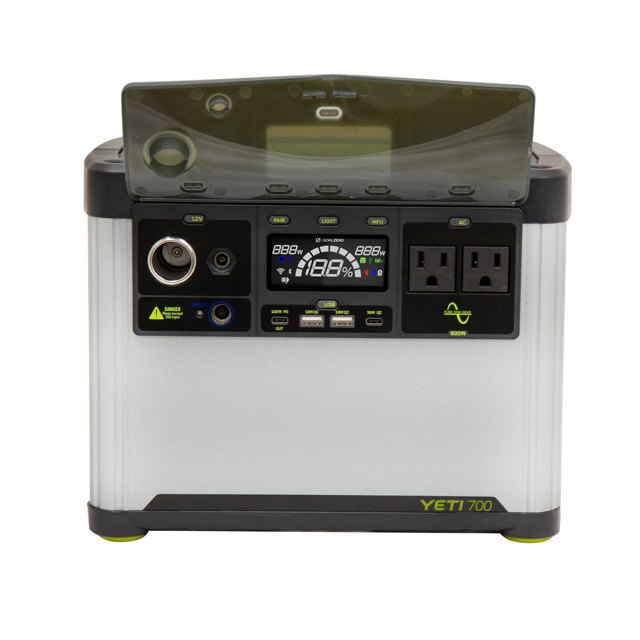
Goal Zero Yeti 700
70% usable at 34 W — the most efficient small-load unit measured.
Buy this if: You run small loads for a long time and want the unit that wastes the least doing it.
The catch600 W: will not start most refrigerators.
Why we say that — and where it falls short
Not really a 1 kWh unit — 677 Wh and only 600 W out — but it measured 70% usable at 34 W, the best low-draw efficiency in the measured group.
What it does well
- 70% usable at 34 W: the best small-load efficiency measured
Where it falls short
- 600 W continuous will not start most refrigerators
- Nearly two hours to recharge on AC
- Costs about the same as the 1,800–2,000 W units above
Specs: goalzero.com; Outdoor Life weight/recharge. We earn nothing on this brand; linked anyway.
Home backup — 2 kWh and up
A fridge for half a day, a CPAP for four nights. Expandable with extra batteries; some do 240 V.
Anker SOLIX S2000
2,010 Wh for $650 — the cheapest watt-hours of any portable unit here; only a fixed 48 V home battery beats it.
Buy this if: You want two kilowatt-hours of runtime for the least money and your loads are modest.
The catch1,500 W continuous: a big battery with a small inverter.
Why we say that — and where it falls short
2,010 Wh with a 10,000-cycle rating for $650 on Amazon — the lowest cost per watt-hour in this comparison by a wide margin. The catch is in the listing title: 1,500 W continuous, the same as the 1 kWh Jackery. It is a big battery with a small inverter.
What it does well
- 10,000-cycle rating — 2.5× the others
- Lowest price per watt-hour here, and a UPS mode
- Anker's app carries over from the C-series
Where it falls short
- 1,500 W continuous: a space heater is the ceiling, and a microwave plus anything else is not
- No 240 V; expansion only by buying a second unit (Anker sells a 2-pack)
Specs: Amazon listing title (2,010Wh, 1,500W, UPS); ankersolix.com (10,000 cycles, 3,000 W peak). We earn nothing on this brand; linked anyway.

Jackery Explorer 2000 Plus
3,000 W today and a path to 24 kWh and 240 V.
Buy this if: You are buying the first piece of a system, not a box.
The catchHeavy, and two hours to recharge.
Why we say that — and where it falls short
3,000 W continuous, 6,000 W surge, and a path from 2 kWh to 24 kWh and 240 V by adding packs and a second unit. The one to buy if you expect the outage to get longer next year.
What it does well
- 3,000 W / 6,000 W surge starts well pumps and 240 V gear (with a second unit)
- Expansion path is the deepest in the group
- 4,000-cycle LiFePO4
Where it falls short
- Heavy; wheels help, stairs do not
- Two-hour recharge is slower than the 1 kWh units
Specs: jackery.com; Amazon listing title. Affiliate programme pending — this link earns us nothing today.

BLUETTI Elite 200 V2
2,074 Wh and 2,600 W for $799.
Buy this if: The Amazon price undercuts the Jackery and you do not need 240 V.
The catchCycles, weight and expansion not verified.
Why we say that — and where it falls short
2,074 Wh and 2,600 W continuous puts it between the Anker and the Jackery on output, at a price that undercuts the Jackery — with 654 Amazon ratings at 4.7 stars behind it. What we have not verified is cycles, weight, recharge time or the expansion path.
What it does well
- 2,600 W continuous on paper
- Cheaper than the Jackery 2000 Plus for similar output
Where it falls short
- Cycles, weight, recharge time and expansion not verified
Specs: bluetti.com; Amazon listing title (2073.6Wh 2600W). We earn a commission if you buy through this link.
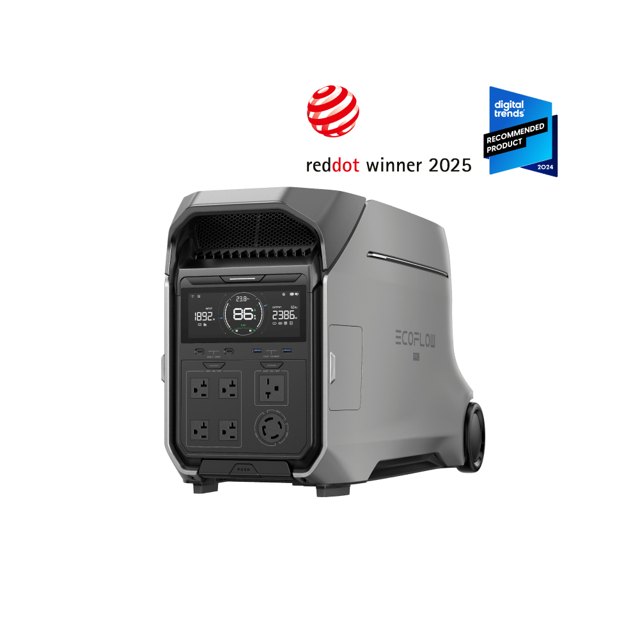
EcoFlow DELTA Pro 3
4 kWh, 4,000 W and 240 V from a single box.
Buy this if: You need 240 V today, or you are wiring it in with a transfer switch.
The catchA two-person carry at a premium price.
Why we say that — and where it falls short
4 kWh, 4,000 W continuous, 120/240 V from a single unit and 2,600 W of solar input. This is the category's ceiling for one box; above it you are shopping for a home battery.
What it does well
- 120/240 V split-phase from one unit — no second unit needed
- 2,600 W solar input; 4,000 cycles; 5-year warranty
- Expansion to 36 kWh
Where it falls short
- Price and weight are in another league — it is a two-person carry
Specs: ecoflow.com; Amazon listing title. We earn nothing on this brand; linked anyway.

BLUETTI Apex 300
3,840 W, a 65-minute recharge, expansion to 58 kWh.
Buy this if: You want DELTA Pro 3 class output with a BLUETTI expansion ecosystem.
The catchOnly 70 Amazon ratings so far.
Why we say that — and where it falls short
2,765 Wh and 3,840 W continuous in one box, 0–100% in 65 minutes on TurboBoost, and an expansion ceiling BLUETTI puts at 58 kWh. It is the BLUETTI to compare against the DELTA Pro 3, at roughly two-thirds of the capacity.
What it does well
- 3,840 W continuous — more than the Jackery, close to the EcoFlow
- 65-minute full recharge is the fastest in this tier
- Deepest stated expansion path on the page
Where it falls short
- 70 Amazon ratings: new, thin owner history
- Cycles, weight and surge not in the listing title; left blank
Specs: Amazon listing title (2764.8Wh 3840W); Notebookcheck (65-min TurboBoost, 58 kWh expansion). We earn a commission if you buy through this link.
ECO-WORTHY 48V Home Backup 5,120 Wh
About $0.30 per Wh — a third of anything portable.
Buy this if: You are wiring backup into the house and only ever wanted the price per kilowatt-hour.
The catchNot portable: a stationary 48 V battery that needs wiring.
Why we say that — and where it falls short
Included to mark where the category ends. Five kilowatt-hours and a 5,000 W inverter for $1,550 is a third of the price per watt-hour of anything above. That is because it is a stationary 48 V battery with an inverter, not a box with a handle. If you never need to move it, this is the arithmetic.
What it does well
- About $0.30 per watt-hour on Amazon; nothing portable comes close
- 5,000 W inverter
Where it falls short
- Not portable and not plug-and-play: this is a wiring job
- 44 Amazon ratings; cycles, weight and solar input not in the title
Specs: Amazon listing title (5120Wh LiFePO4, AC 5000W inverter). We earn a commission if you buy through this link.
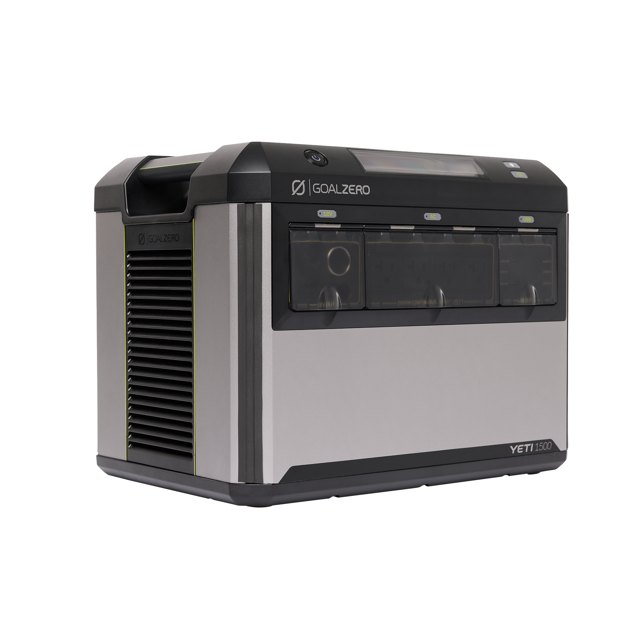
Goal Zero Yeti 1500
The Yeti ecosystem with 2,000 W of output.
Buy this if: You are already invested in Goal Zero gear.
The catchThe least capacity per dollar in this tier.
Why we say that — and where it falls short
1,505 Wh / 2,000 W at $1,499.95 list: less capacity than the Anker S2000 for about twice the money. Listed so the comparison is honest, not because we would buy it.
What it does well
- LiFePO4; the Yeti ecosystem of panels and accessories
Where it falls short
- Least capacity per dollar in this tier by a large margin
- Surge, weight, recharge not on the page we checked
Specs: goalzero.com collection page. We earn nothing on this brand; linked anyway.
Shopping in Germany for balcony solar with storage instead? Different product, different rule set (800 W feed-in cap): see our Balkonkraftwerk mit Speicher comparison.
What we did not do
We did not run capacity tests; we report Outdoor Life’s. We did not weigh units or time recharges; those columns come from maker pages and Amazon listing titles, checked September 2026, and where a maker’s page did not state a figure we left it blank rather than copy it from a retailer. Prices move weekly in this category — the link shows the live one.
BLUETTI (10%) and ECO-WORTHY (5–10%) pay us a commission when you buy through our tagged links. Anker’s affiliate programme covers our advertising channel but not this site, so Anker links here are plain and earn nothing; EcoFlow and Goal Zero pay us nothing; Jackery’s programme is pending. Two of our three tier picks (EcoFlow, Anker) earn us nothing — that is the ranking, not a tactic. Rankings were settled before any link was added.