Compressor or nothing: a thermoelectric cooler sits in the USDA danger zone in a warm room. Then knock a fifth off the advertised can count.
Three jobs, one pick each
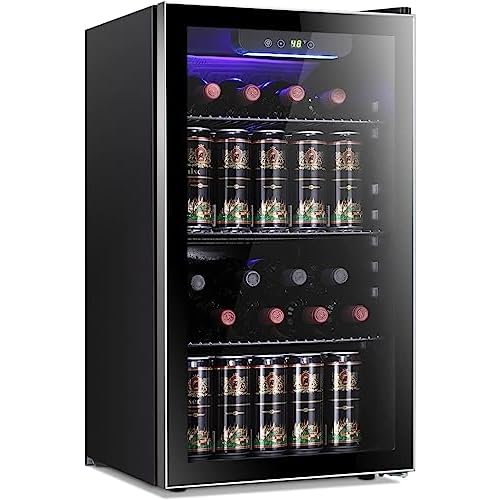 Antarctic Star 3.2 cu ft
2,047 Amazon ratings at 4.4 — nearly five times the buyer evidence of any other unit here.
The catch: 3.2 cu ft is the smallest cabinet; manual defrost once a year.
 Kismile 4.5 cu ft
4.5 cu ft for $270 — the cheapest cold volume of the five, with a digital setpoint.
The catch: Needs floor space, and 425 reviews is a fifth of the Antarctic Star’s sample.
 EUHOMY 24″ built-in
Front-venting at $590 — the cheapest of the three that can sit flush in a cabinet run.
The catch: $590 — you pay roughly double per cubic foot for the venting.
Prices and ratings: Amazon, checked 2026-08-15. The outdoor and dual-zone EUHOMY/BODEGA units are in the table and the cards below — buy them only for the rating or the second zone; per cubic foot they cost 2–3× the Kismile.
All five, side by side
Capacity per dollar is the column most guides leave out, and it explains the price spread. The two most expensive cabinets are not buying you more room. They are buying an outdoor rating or a second temperature zone.
| Unit | cu ft | Cans, realistic | $ / cu ft | Installs as | Defrost | Amazon | |
|---|---|---|---|---|---|---|---|
| All five — every one is compressor-cooled | |||||||
| 3.2 | 105 | $62 | Freestanding | Manual | $200 ★4.4 · 2,047 | Amazon → |
| 4.5 | 118 | $60 | Freestanding | Automatic | $270 ★4.2 · 425 | Amazon → | |
| 5.3 | 147 | $111 | Built-in | Frost free | $590 ★4.4 · 272 | Amazon → | |
| 4.9 | 98 | $153 | Built-in · Outdoor | Frost free | $750 ★4.2 · 212 | Amazon → | |
| 4.1 | 46 | $195 | Built-in · Dual zone | Automatic | $800 ★4.4 · 143 | Amazon → | |
Highlighted = most capacity, cheapest per cubic foot. Realistic cans = the advertised count less the airflow allowance (see below). Prices and ratings: Amazon, checked 2026-08-15.
All specifications: dimensions, weight, shelves, temperature range, sources
| Unit | D × W × H in | Weight | Shelves | Temp range | Source |
|---|---|---|---|---|---|
| 19.3 × 17.5 × 31.2 | 48.5 lb | 4 wire | — | Amazon listing, read 15 August 2026 |
| 21.9 × 20.3 × 31.5 | 59.8 lb | 5 wire | — | Amazon listing, read 15 August 2026 | |
| 22.6 × 23.4 × 34.3 | 85 lb | 3 wire | 37–65°F | Amazon listing, read 15 August 2026 | |
| 22.6 × 23.4 × 34.3 | 92.6 lb | 2 wire | 37–65°F | Amazon listing, read 15 August 2026 | |
| 22.7 × 23.4 × 33.4 | 97 lb | Wood racks | — | Amazon listing, read 15 August 2026 |
A thermoelectric "fridge" cannot hold food out of the USDA danger zone
It has no compressor. It moves heat with an electric current, and makers of thermoelectric coolers typically specify a pull-down of only about 20–35°F below whatever the room is. Here is what that means in an 80°F room in August.
Compressor. Same mechanism as your kitchen fridge: it holds the setpoint you choose regardless of how hot the room gets. Every model in this comparison is compressor-cooled — that is the entry requirement, not a feature.
Thermoelectric, in an 80°F room. That is inside the USDA danger zone (40–140 °F), where bacteria multiply fastest. Fine for soda. Not food.
Thermoelectric units are quieter and cheaper — which is exactly why they get bought by the people who needed a compressor. The spec sheet rarely says which one you are buying. Check this first and ignore everything else until you have.
TakeawayIf food goes in it, it needs a compressor. Every unit on this page has one; the cheapest is the Antarctic Star at $200. → Antarctic Star 3.2 cu ft · check price
Then discount the capacity claim by about a fifth
There is no industry standard for measuring a can count. Nobody publishes the can size or shelf layout the number assumes — which is how two nearly identical 4.5 cu ft cabinets end up rated 145 cans and 126 cans. One widely repeated hands-on check — we could not trace it to a linkable source — put a 115-can claim at 95–100. That is what is left once you leave room for air to move, and airflow is not optional: it keeps the temperature even from top to bottom. Treat the −20% as a rule of thumb, not a measurement.
TakeawayBuy for the realistic number, not the box. Anything tall — 16 oz cans, standing bottles, a growler — means pulling a shelf and losing a whole row; subtract more. The Kismile keeps the most cans per dollar. → Kismile 4.5 cu ft · check price
The five, one by one
Antarctic Star 3.2 cu ft Beverage Fridge
2,047 Amazon ratings at 4.4 — nearly five times the buyer evidence of any other unit here.
Buy this if: You want a real fridge, not a cooler, and you want the model with the most buyer evidence behind it.
The catch3.2 cu ft is the smallest cabinet; manual defrost once a year.
Why we say that — and where it falls short
The only unit here with a four-figure review count. 2,047 ratings at 4.4 stars is, nearly five times the next-largest sample, and the strongest real-world evidence here.
What it does well
- By far the most reviewed unit in this price band — sample size is what makes it trustworthy
- Compressor cooling, so it holds temperature in a warm room
- The cheapest way into a real fridge rather than a thermoelectric cooler
Where it falls short
- 3.2 cu ft is the smallest here; treat the 130-can claim as roughly 105 in practice
- Freestanding only — do not build it into a cabinet run
- The only manual-defrost unit here — you will be emptying it and thawing it by hand once a year
Specs: Amazon listing, read 15 August 2026. This link pays us a commission.
Kismile 4.5 cu ft Beverage Refrigerator
4.5 cu ft for $270 — the cheapest cold volume of the five, with a digital setpoint.
Buy this if: You want the most cold volume under $300 and you have the floor space for it.
The catchNeeds floor space, and 425 reviews is a fifth of the Antarctic Star’s sample.
Why we say that — and where it falls short
4.5 cu ft for $270 is the best volume-per-dollar here, and it adds a digital setpoint that the cheaper unit does not have.
What it does well
- Largest capacity under $300 in this group
- Digital temperature control rather than a dial — matters if you actually care about holding 38°F
- 425 reviews at 4.2 is a reasonable evidence base
Where it falls short
- 145 cans is the most optimistic claim here — budget for about 118
- 4.2 is the joint-lowest average; read the recent one-stars before buying
- Freestanding, and it needs clearance on all sides
Specs: Amazon listing, read 15 August 2026. This link pays us a commission.
EUHOMY 24-inch Built-in Beverage Cooler
Front-venting at $590 — the cheapest of the three that can sit flush in a cabinet run.
Buy this if: It is going into a kitchen island or bar run and has to sit flush, not stand in a corner.
The catch$590 — you pay roughly double per cubic foot for the venting.
Why we say that — and where it falls short
The cheapest genuinely built-in unit here. Front-venting is the whole point — it is what lets a fridge sit flush in a cabinet run without slowly cooking itself.
What it does well
- Front-venting, so it installs under a counter with no ventilation gap
- 180-can class capacity inside a 24-inch footprint
- 4.4 average across 272 reviews
Where it falls short
- Built-in installation is not reversible — measure the cutout twice
- Roughly double the freestanding units for similar internal volume
- Single zone: one temperature for everything inside
Specs: Amazon listing, read 15 August 2026. This link pays us a commission.

EUHOMY 24-inch Outdoor Double Drawer Fridge
Weather-rated double drawers — the only one on the page built to live outside.
Buy this if: It is going outside. If it is going inside, buy something else on this page.
The catch$750; indoors it is simply an expensive drawer fridge.
Why we say that — and where it falls short
Outdoor rating is a different product class, not a marketing word. An indoor fridge on a patio typically fails inside one season.
What it does well
- Genuinely rated for outdoor use — sealed against humidity and temperature swing
- Drawers mean you are not holding a door open while the cold falls out
- Stainless construction built for weather
Where it falls short
- 212 reviews at 4.2 is the thinnest evidence base in this group
- Drawers hold less than a door unit of the same external size
- A large premium for the outdoor rating — poor value if it lives indoors
Specs: Amazon listing, read 15 August 2026. This link pays us a commission.

BODEGA 24-inch Dual Zone Wine & Beverage
Two zones — wine at 50–55 °F on one side, cans at 36–38 °F on the other.
Buy this if: You keep wine and cans in the same place and are tired of one of them being at the wrong temperature.
The catch$800 on 143 reviews: the thinnest evidence base here.
Why we say that — and where it falls short
The only dual-zone unit here. Wine wants 50–55°F and cans want 36–38°F — a single zone forces you to compromise one of them, permanently.
What it does well
- Two independently controlled zones — 57 cans one side, 19 bottles the other; nothing else here does this
- Built-in capable at 24 inches
- 4.4 average, with both zones separately reported as holding temperature
Where it falls short
- 143 reviews is a modest evidence base for an $800 appliance
- 4.1 cu ft is the least usable volume of the three 24-inch units, because the split costs space
- Overkill if you only store cans — you pay for the wine zone either way
Specs: Amazon listing, read 15 August 2026. This link pays us a commission.
Choose in about a minute
Will it hold food, or only drinks?
Food means compressor. No exceptions, no matter how good the price looks.
Freestanding, or flush into a cabinet?
A back-venting unit cannot go in a cabinet run — it will slowly overheat. Built-in capable means front-venting, and it costs roughly double.
Indoors or outdoors?
An indoor fridge on a patio typically fails within a season. Outdoor rating is a real product class, not a marketing adjective.
One temperature or two?
Wine wants 50–55°F, cans want 36–38°F. A single zone means permanently compromising one. For wine on one side and cold cans on the other under a counter, read our 24-inch dual-zone comparison — most “dual zone” units cannot get a can cold.
Where exactly does it sit?
Every compressor unit hums. Next to a desk that is fine. At the foot of a bed it is the thing you notice at 2am.
Three noises worth acting on
A steady hum is the compressor working. These are not:
- A cricket-like chirp
- Usually the evaporator fan bearing. Cheap to fix early, expensive later.
- A hum that keeps getting louder
- The compressor is struggling. This is the one that ends in a dead unit.
- Banging or rattling
- Often just the compressor mounting bolts working loose. Frequently a five-minute fix.
A well-made compressor unit should give you 8–12 years. Clean condenser coils and real ventilation clearance decide whether you get the top or the bottom of that range.
What we did not do
We compared specifications, live pricing and the full review distribution for each unit — not just the headline average. We did not run these side by side in a lab, and we would rather say so than imply otherwise. Where a model has a thin review base we have flagged it, because for an $800 appliance, 143 reviews is a real limit on how much anyone can honestly tell you.
Prices: Amazon, checked 2026-08-15. Every unit on this page is compressor-cooled — the two we did not pick are the outdoor and dual-zone cabinets in the table above.
All five links pay us a commission when you buy through them. That is why the ranking was settled before any link was added — and why our top pick is the $200 unit, not the $800 one: the cheapest cabinet here also earns us the least.